


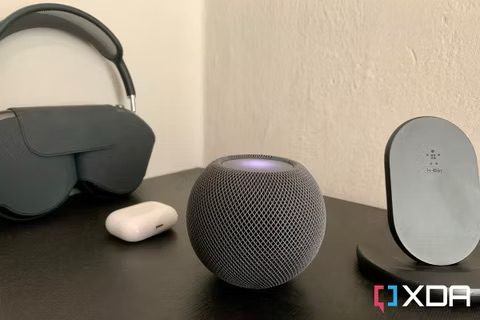
February 9, 2018: Apple launches the HomePod, a $349 smart speaker that promises to reinvent how people listen to music at home.
Phil Schiller called it "a magical new music experience from Apple," one that brought "advanced audio technologies like beam-forming tweeters, a high-excursion woofer and automatic spatial awareness" into a small, mesh-covered cylinder. The reviews largely agreed — on the sound, at least.
Unfortunately, the HomePod’s biggest first-week headline had nothing to do with audio quality. It left white rings on wooden furniture.
A speaker that stained your table (and Apple’s pride)
The HomePod was supposed to arrive in December 2017, just in time for the holidays. It didn’t. Apple delayed the launch by two months, then shipped it only in the U.S., U.K., and Australia. Canada, France, and Germany had to wait until June.
And the price. At $349, the HomePod cost more than three Amazon Echo speakers combined. Apple wasn’t trying to compete on smarts or affordability — this was a music-first device that happened to have Siri bolted on. Don’t get me wrong, the audio quality was legitimately excellent. Multiple reviewers compared it favorably to speakers costing thousands of dollars.
But Siri couldn’t set multiple timers.
Siri couldn’t make phone calls.
Siri couldn’t even recognize different voices.
Viewed from today’s vantage point, the original HomePod was something of a beautiful contradiction: best-in-class sound trapped inside a walled garden so restrictive that it couldn’t natively play Spotify. You could AirPlay it from your phone, sure, but asking a $349 speaker to rely on workarounds felt like buying a sports car that only ran on one brand of gasoline.
And then there was #RingGate. Within days of launch, owners discovered that the HomePod’s silicone base left defined white circles on oiled and waxed wood surfaces. Apple’s official response? It’s "not unusual" for speakers with silicone bases. Their advice: try a different surface. An accessory maker promptly started selling a $19.95 leather coaster for the HomePod. Remember those? Yeah, we thought not.
Sales told the real story. Strategy Analytics estimated Apple shipped roughly 600,000 HomePods in Q1 2018 and 700,000 in Q2 — around 1.3 million units worldwide in the first six months. Apple’s own stores were reportedly moving fewer than 10 units per day at some locations. By April 2019, Apple took the rare step of cutting the price to $299.
The speaker that wouldn’t die
Of course, the HomePod saga didn’t end there. Apple discontinued the original in March 2021, seemingly admitting defeat. And then, in January 2023, it brought back an almost identical model — same shape, same $299 price, but with five tweeters instead of seven and a new "midnight" color option. The second-generation HomePod was far more repairable than the glue-drenched original, at least.
As strange as it seems today, the HomePod’s journey mirrors Apple’s broader smart home struggles. In 2026, Apple is reportedly preparing its most ambitious home push yet — a 7-inch display-equipped smart hub, a new HomePod mini, and possibly a home security camera, all expected by spring. The whole effort hinges on a dramatically improved Siri powered by Apple Intelligence, which has been delayed repeatedly. These days, Apple often takes heat for Siri’s persistent shortcomings, and the irony is thick: the company that shipped a speaker it called "magical" in 2018 still can’t get its voice assistant to reliably compete with Alexa or Google Assistant eight years later.
The HomePod didn’t fail because it sounded bad. It failed — at least the first time around — because Apple built something of a high-fidelity island and expected everyone to swim to it.