





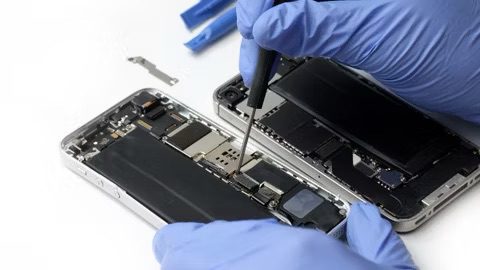
This article explains why Apple’s repairs are so expensive. Because if you’ve ever cracked your iPhone’s screen and taken it to the Apple Store to get it repaired, you may have been shocked by just how pricey it was. I recently shattered the corner of my three-month-old Apple Watch, and getting the screen replaced would have cost me $300, which is about 70% of the watch’s retail price. So it made more sense for me to just buy a new one. Stories like these have only become more common as Apple’s repair prices have been on the rise.
There is something I want to make clear before we discuss Apple in particular: the repair cost of almost all electronics have been steadily increasing for the past decade. It’s certainly not a phenomenon exclusive to Apple. I’m simply using Apple as a prime example, since it’s the company I’m most familiar with, and because they do happen to charge a little more for repairs than their competition.
In order to understand why Apple’s repair prices are so high today, we have to begin by taking a look at how their products have developed over the years. Because it’s very easy to look at this issue and jump to the conclusion that Apple’s just being greedy and trying to make more money, but it’s actually much more complicated than that. Products like the iPhone, iPad, and MacBook have all changed in many ways since they were first released, and some of those upgrades came at the cost of repairability.
If you were around for the MacBook’s early days, you’ll probably remember its user-replaceable battery that could easily be swapped out. This was considered by many to be a necessary feature because that’s when the MacBook’s estimated battery life was just five hours, about a quarter of what it is today. So many users carried around a fully charged backup to replace the battery once it was depleted, and the ability to instantly charge your notebook was a huge convenience for users on the go.
But in 2008, Apple released the new MacBook Air, which featured a non-removable battery. At first, this decision didn’t go over well with customers, who could no longer enjoy the convenience of battery swapping and would be forced to pay for pricey battery replacements once it degraded. But it didn’t come without its benefits. The battery technology used in the original MacBook Air was pretty groundbreaking for its time and was the primary reason why the product even existed. Instead of using traditional cylindrical lithium-ion cells, Apple created custom lithium-polymer cells that were thin and rectangular, which allowed the battery to fill up the entire volume of the Air’s chassis, leaving no wasted space. Also, by making the battery non-removable, Apple could do away with components that took up valuable space for the battery. All of these changes allowed Apple to squeeze in 30% more battery and make the product dramatically thinner than any MacBook before it. So for Apple, the benefits of a non-removable battery outweighed the drawback of more expensive replacements and repairs.
Another good example is with the iPad. When the original was introduced in 2010, it featured a non-laminated display, which meant the front glass was separated from the LCD panel underneath. You could actually see a small gap between the two. So if you happened to crack the screen, it could be replaced fairly easily and affordably, since all that needed to be replaced was the front piece of glass.
But this changed beginning with the iPad Air 2 in 2014. It was upgraded to a laminated display, where the glass and LCD panel were actually fused together into one unit. Just like with the MacBook Air’s battery, it came with advantages and disadvantages. One nice thing was that the gap of air under the glass was no longer there. So when you tapped on the display, the pixels were much closer to your fingertips, which made interactions feel more natural. This would become even more important when Apple introduced the Apple Pencil in 2015. Also, the laminated display allowed the iPad to be even thinner, which was a big selling point of the iPad Air 2. But the disadvantage was that if your iPad screen cracked, the front glass and LCD panel needed to be replaced, which made the repair cost skyrocket.
These examples demonstrate the struggle companies like Apple face when trying to create the most appealing product on the market. Because the reality is, for most customers, a thin and light device will always be more desirable than a thicker, heavier device with a removable battery and non-laminated display. So it isn’t much of a surprise that companies like Apple don’t make repairability a priority when designing products.
But there’s more to the story than this. So far we’ve discussed why parts have become more expensive, but there’s actually another element that has a far greater influence on repair costs. And that’s labor. Because if you think about it, Apple products, with the exception of the Mac Pro, are all made in China and increasingly in India, where labor is cheap and assembly lines are efficient. So labor costs per unit are kept to a minimum. But when you go to an Apple store to get something repaired, you’re essentially hiring a worker from your home country to disassemble and reassemble your device by hand, which can be a very time-consuming and challenging process, especially with something like the Apple Watch, which wasn’t designed to be taken apart. And that’s why a screen replacement for the Apple Watch is actually more expensive than many iPhone models, priced at $300 for aluminum Series/SE models and $500 for Ultra models, compared to $279 for most recent iPhones. It isn’t the display itself that’s pricier, but rather the labor.
Now I want to discuss an issue that’s been brought up a lot lately. Where Apple’s Genius Bar workers incorrectly diagnose issues with products, and this has resulted in users paying exorbitant repair fees for services they don’t even need. In fact, back when my Series 3 Apple Watch was experiencing random shutdowns, employees at my local Apple store advised me to purchase a battery replacement for $80, since it must be degraded or faulty. But I decided against it, and after leaving my watch on its charger for over 24 hours, I never had an issue with it shutting down again.
I don’t mean to suggest that Apple employees are maliciously misleading users into purchasing repairs they don’t need. I just think when you have people working in a fast-paced retail setting, decisions have to be made quickly. And when wrong decisions are made, it comes at a significant expense to the users. So considering how pricey it can be to repair an Apple product, I’d like to see more deliberate care taken by the company to ensure issues are being correctly diagnosed.
I should also point out that Apple puts a lot of pressure on their retail employees to attach AppleCare warranties onto as many product sales as possible. Although they don’t earn a commission, employees do receive perks or punishments depending on how many AppleCare warranties they sell. I’ve even heard of workers being fired for failing to meet monthly sales goals for AppleCare. And this shouldn’t be too surprising considering AppleCare is part of Apple’s services business, a business the company has been growing aggressively for years. In fact, services is Apple’s second largest source of revenue at over $30 billion quarterly, representing more than 26% of total revenue and significantly ahead of the iPad and Mac. And this leads many to believe Apple’s trying to encourage sales of AppleCare by showing customers how expensive repairs are out of warranty. And while I believe there might be some truth to this, you’ll also have to consider that most of Apple’s repair prices aren’t that much more than their competition. And as I mentioned before, I think it has more to do with how modern devices are being made and how much labor is required to make the repair.
But I think the most concerning part of all this is Apple’s evolving stance on their customers’ right to repair. For many years, only Apple-authorized repair shops had access to Apple’s training, official repair literature, and opportunity to buy genuine parts directly from Apple. The problem was third-party shops had to pay a fee to become authorized and were only allowed to make basic repairs. In fact, one shop owner said, "If I became Apple certified, I would lose 75% of my opportunities to do repairs on things and would have to send that business to Apple for a small finders fee." And because Apple had a monopoly on the majority of repairs, their costs tended to be higher than necessary.
However, Apple’s position has changed significantly in recent years. In 2022, Apple launched its Self Service Repair program, which allows customers to purchase genuine Apple parts, tools, and repair manuals to fix their own devices. The program initially covered iPhone 12 and 13 models and has since expanded to include more devices and Mac computers. In 2023, Apple made a dramatic shift by publicly endorsing California’s right-to-repair laws, marking a reversal from years of opposition to such legislation. Since then, several U.S. states including California, Colorado, Minnesota, New York, Massachusetts, and Oregon have passed comprehensive right-to-repair laws between 2023 and 2025.
These laws make it easier for people to repair their own devices by requiring manufacturers like Apple to reveal repair information to the public and sell spare parts directly to users and third-party repair shops. That way, consumers have more options when it comes to making repairs, rather than being forced to go to Apple and pay whatever price they’re asking. Apple has also expanded its Independent Repair Provider program, which gives qualifying third-party repair shops access to genuine parts, tools, and training for out-of-warranty repairs.
While Apple’s main argument for controlling repairs has been that being a provider of most repairs protects their intellectual property, consumer safety, and device security, there may be some truth to that. However, the company has shown that it can implement systems that give users more control and more choice when it comes to who repairs their products. The recent legislative momentum and Apple’s policy shifts suggest the tech industry is moving toward greater repair accessibility, which could help reduce electronic waste and lower costs for consumers.
So while the costs of parts and labor are a major reason for high repair prices, there are other contributing factors, like the fact that tech companies have historically maintained significant control over most repairs made to their devices. However, with new right-to-repair laws and Apple’s Self Service Repair program, the landscape is changing. This appears to be driven by years of consumer advocacy, legislative pressure, and growing concerns about electronic waste. I hope Apple, considering their prominence and size, will continue to stand up for users’ control over the products they own, as this could help push the entire industry toward the democratization of product repairs.
That’s why Apple repairs are so expensive.
Thanks for reading.
See also: Why iPhones Are Made In China